Restoring a Thorens TD-124
Most of what I fix lives behind a terminal — packets, kernels, daemons. This one I fixed with a torque driver, a tin of bearing oil, and a lot of patience. Over a few winter weekends I brought a 1958 Thorens TD-124 back from the dead: a Swiss idler-wheel turntable that, when everything is right, spins with a mechanical authority nothing belt-driven and modern quite matches.
Mine was not right. It came sight-unseen from an estate sale — a boat anchor that used to be the best transcription table of its era: a seized main bearing, an idler wheel gone hard and flat-spotted, a motor that hummed like a transformer, perished suspension, and wiring that crumbled when I looked at it. The plan was simple and slightly mad: take the whole thing apart and replace everything that wears.
Why the TD-124 is worth the trouble
The genius is in the drive, which refuses to pick a side. A small E50 motor turns a stepped brass pulley through a tiny belt — the belt isolating motor buzz — and a rubber idler wheel then carries that motion to the inner rim of a ten-pound cast-iron platter. You change speed (16, 33, 45, 78 rpm) by walking the idler up and down the steps of the pulley. An eddy-current magnetic brake lets you trim the speed by hand against a built-in strobe.
Then there’s the party trick: a two-piece platter. A light aluminium top platter sits on the heavy cast-iron one through a clutch, and a lever lets you lift it — stopping the record dead for cueing — while ten pounds of iron underneath never loses a single rpm. It is gloriously over-engineered, and it is exactly that heft that makes it sound the way it does.
The teardown: replace everything that wears
I stripped it to the last screw. Photographed every step, bagged every fastener, and rebuilt from the bearing out.
The idler wheel was the obvious culprit — glazed and flat-spotted, the source of a low rumble — so it went out to be re-rubbered to spec. The belt was new, the main bearing got a fresh thrust pad, a new ball, and clean oil, and the E50 motor came apart for new bushings, fresh oil wicks, and a new run capacitor (that old paper cap was the hum). The four suspension springs — the “mushrooms” the chassis floats on — had hardened flat, so a new set went in and the whole chassis was re-leveled to float free. Then new internal wiring, fresh RCA leads and ground, a cleaned-up switch and speed linkage, and a service of the eddy-current brake and strobe.
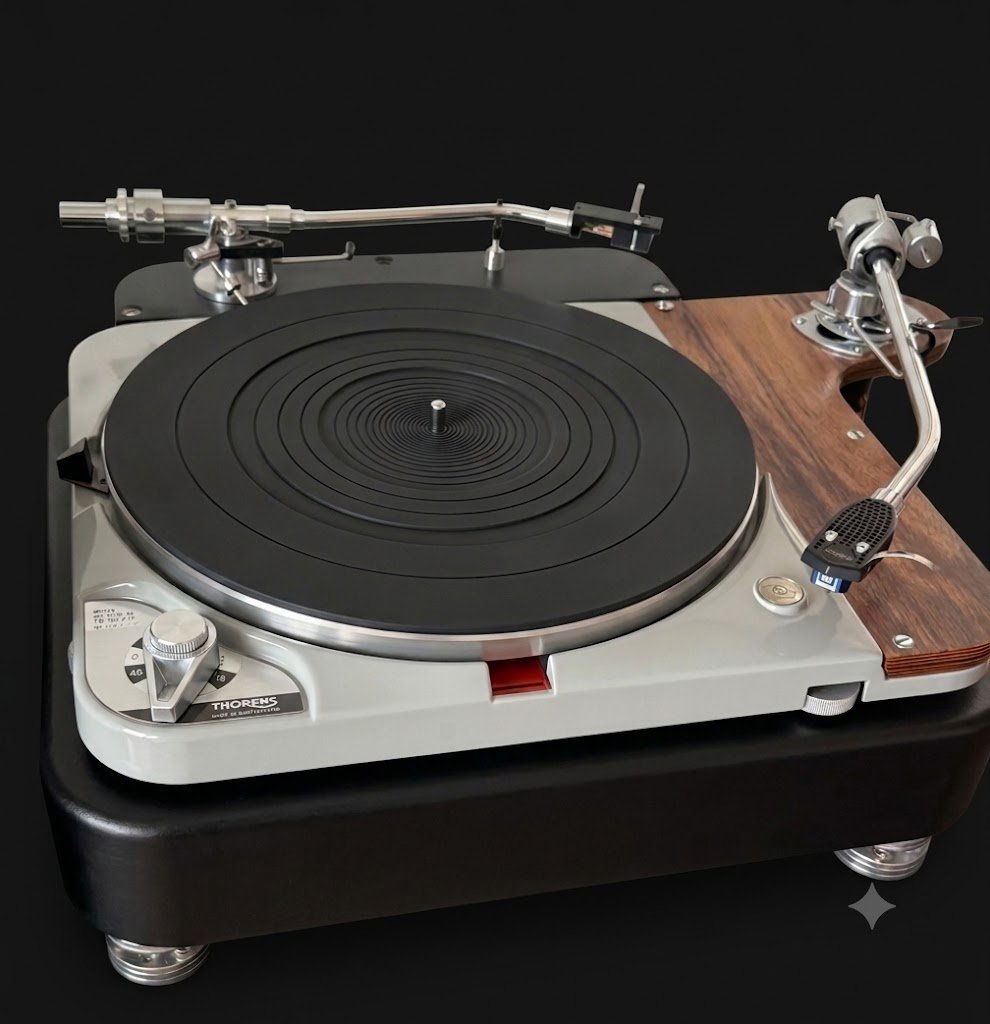
The original plinth was tired, so I built a new one out of solid walnut and fitted a pair of classic arms — an SME 3009 among them — and an Ortofon cartridge, the kind of pairing this table was practically designed for.
The fiddly bits
The hard part of an idler deck isn’t the big parts; it’s the adjustments. The idler has to press the platter rim hard enough not to slip, but not so hard that motor rumble telegraphs straight into the record. The suspension has to float dead level so the arm tracks true. The magnetic clutch height has to be just so. And the eddy brake gets dialed until the strobe dots freeze stone-still — the moment the whole machine finally agrees on a speed.
First spin
I leveled it, set the tracking force, dropped the needle on a well-worn jazz pressing, and waited for the strobe to lock. It locked. What comes off a properly sorted TD-124 isn’t subtle: the noise floor drops away, the bass has body and stops dead when the music does, and there’s a steadiness to the pitch you can feel more than hear — the dividend of all that spinning iron.
It’s a different kind of debugging than my day job, and somehow the same. Instead of tracing a packet through a kernel, I traced torque from a motor, through a belt, through an idler, into ten pounds of iron — finding every worn link in the path and renewing it until the whole thing ran true. Understand the system end to end, replace what’s broken, make it sing. Sixty-eight years on, it still does.