Wall of Sound: Inside My Stereo Guitar Rig
Most of what I build lives behind a terminal — packets, daemons, routing tables. This one I built with a soldering iron, a tuner, and an indefensible number of pedals. It’s a guitar rig, and like everything else I can’t leave alone, it quietly turned into a signal-routing problem — just one you can hear.
Here’s the scene: a rack of headless guitars standing at attention, a matte-black King V leaned against the cab like a weapon set down between takes, two tube heads glowing the same cold blue, and a floor-wide pedalboard wired up in every color of the rainbow. It looks like a patch panel that learned to play metal. The whole thing runs in true stereo — two amps, two cabs, two independent effects loops — and the cable snake it takes to feed all of that is genuinely a little unhinged.
The brief I set myself was simple and contradictory: one rig that can do two opposite things with zero compromise. Crushing, surgically tight progressive-metal rhythm one moment; massive, cinematic ambient cathedrals the next. Here’s how it goes together, from the strings to the speaker cones.
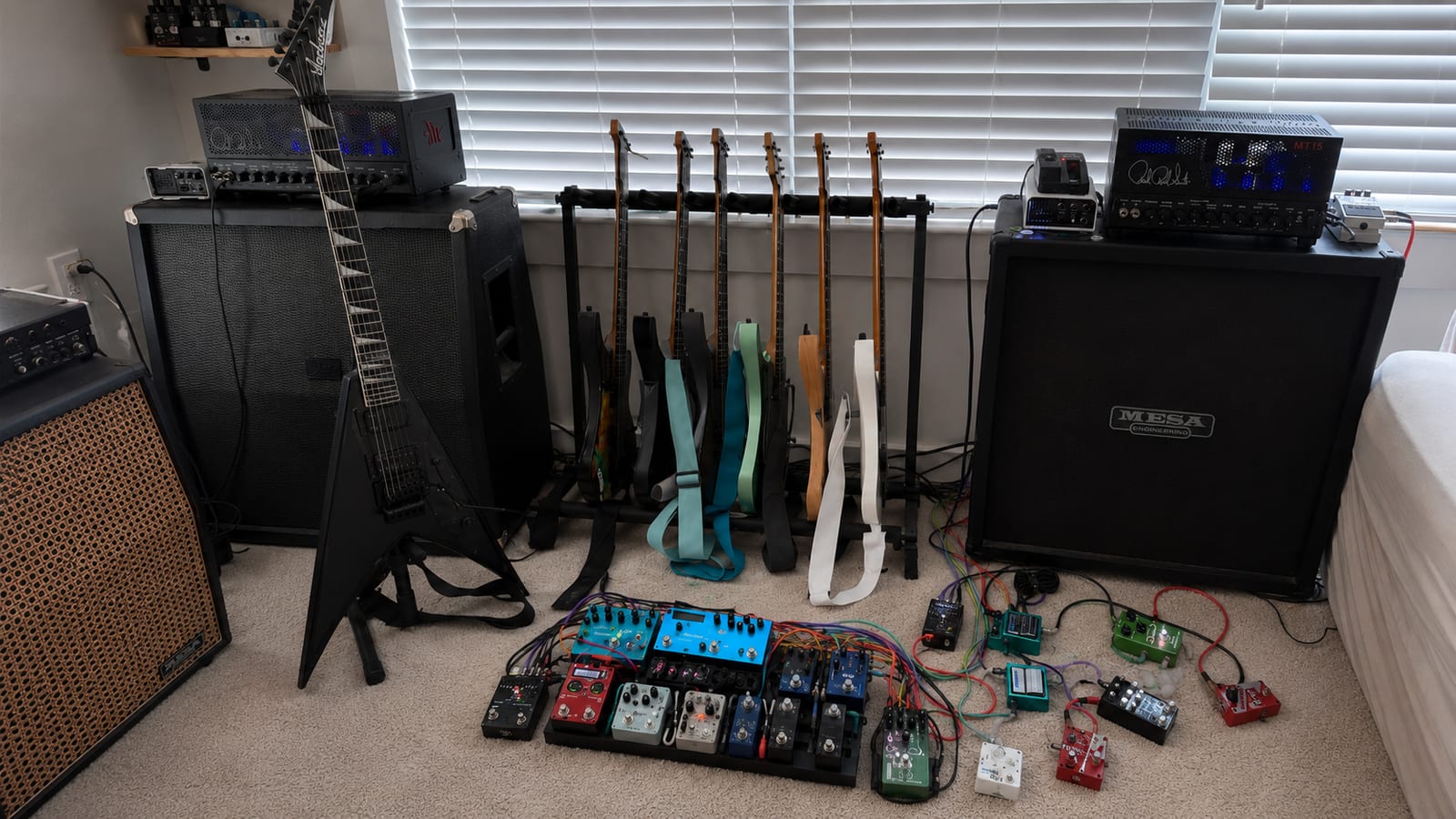
The axes: an ergonomic fleet and one classic outlier
The backbone of the rack is a fleet of .strandberg* headless guitars. If you’ve never held one, the first thing you notice is what isn’t there: no headstock, almost no body mass, and a contoured Endurneck that nudges your fretting hand into a more neutral position. Picking one up after a traditional guitar feels like switching from a tower PC to a laptop — same job, a fraction of the weight, and suddenly a four-hour session doesn’t wreck your shoulder.
The ergonomics are the headline, but the reason they live in this rig is the multi-scale fanned frets. The bass strings sit at a longer scale length than the trebles, which is exactly what extended-range playing wants: drop the low string to a piano-string tension instead of a wet noodle. Tune one of these down into the basement and the low notes stay defined — you hear the pitch, not just a flubby thud. Pair that with near-perfect intonation across the neck and you get the note separation that fast, low, chord-heavy riffing absolutely depends on. When every string is ringing a half-step from chaos, clarity is the whole game.
And then, leaning against the cab, there’s the outlier: a black Jackson KV2 King V with the reverse, pointed, inline headstock. It is everything the Strandbergs aren’t — pointy, a little dangerous, unapologetically traditional. This is the guitar you reach for when the song doesn’t want ergonomics and clarity; it wants attitude. Neck-through speed, a neck that begs you to play too fast, and that unmistakable V silhouette. The fleet is the scalpel. The V is the broadsword.
The core: two heads, two cabs, one wall
The heart of the rig is a PRS MT15 — the Mark Tremonti signature lunchbox — a tiny tube head that punches so far above its 15 watts it’s almost rude. It lives on its high-gain Lead channel, the one you can spot across the room by the blue glow behind the front panel. That channel is the rig’s rhythm voice: thick, punchy low-mids that cut through a mix, and enough headroom that palm-muted chugs stay tight instead of collapsing into mush. It is a remarkably focused high-gain tone, and focus is what tracks well.
Under it sits a rugged Mesa/Boogie 4x12 — the cab half the metal records you own were tracked through, and for good reason. It’s tight, it’s heavy, and it never gets flubby no matter how hard you hit it. On the far side of the room, a secondary high-gain head and cab form the other half of a dual stack: a second, distinct voice waiting in the wings. Together they’re not a louder mono rig — they’re the two halves of a stereo field, which is where this whole thing earns its keep (more on that below). And tucked on the windowsill, a Joyo BantAmp hybrid mini-head stands by for late nights when a full tube stack is a war crime against the neighbors — a genuinely good practice voice in something the size of a paperback.
The board: drives up front, cathedrals in the loop
The pedalboard splits cleanly into two jobs, and understanding that split is the key to the whole rig. Some pedals belong in front of the amp, hitting the preamp; others belong in the effects loop, painting on top of the already-distorted tone. Put a reverb in front of a high-gain amp and you get noise soup; put an overdrive in the loop and it does nothing useful. Order is everything.
Up front — tighten and shift. First in line is a DigiTech Drop, a polyphonic pitch-shifter that drops the tuning a set amount instantly — the difference between “play in drop-A” and “carry six guitars to rehearsal.” Then a Maxon OD808 wired the way metal players actually use a Tube Screamer: gain rolled to zero, level up. It isn’t there for grit — it’s a clean boost that trims the flubby low end going into the amp and tightens the attack, the single most important pedal for a modern rhythm tone. Alongside it, a Joyo Argos overdrive with an onboard gate/attack switch handles the staccato, gated rhythm passages where every chug needs a hard edge.
In the loop — space and width. This is where the cinematic half lives, and it’s built around the Strymon trifecta. The Mobius covers modulation — chorus, phaser, vintage filters, the movement that keeps a clean part from sitting still. The TimeLine is the delay workstation, currently parked on a sprawling “Berlin” preset that smears single notes into a moving wall. And the BigSky — the gold standard of ambient reverb — turns a held chord into a room the size of a planet. Riding with them: a TC Electronic Mimiq doubler for studio-style double-tracking, a TC Electronic Quintessence intelligent harmonizer for instant dual-guitar harmonies, a Boss EQ-200 graphic EQ for surgical frequency carving, and a Boss RC-10R loop station with built-in drum patterns for writing against a groove.
Keeping it honest. All that gain and all that cable has a cost: noise. A Boss NS-2 noise suppressor mounted on the amp head clamps the high-gain hiss using the 4-cable “X” method, gating the signal without strangling the sustain. And at the very end of the chain, a Dr. J Armor buffer fights the signal degradation you get when you drag a guitar tone through this many true-bypass boxes and this much cable — restoring the top end the snake quietly steals.
The crown jewel: two amps, two loops, true stereo
Here is the part that makes the cable snake worth it. This isn’t a mono rig with a stereo reverb bolted on the end. It’s a true stereo rig in which each amplifier runs its own independent effects loop — an advanced dual 4-cable-method setup, two 4CM rigs interlocked. Every spatial pedal has its left side living in the MT15’s loop and its right side living in the second head’s loop. Three things fall out of that, and all three are the reason it exists.
Discrete preamp blending
Because the left and right channels are two different physical preamps, the rig captures two distinct high-gain voices at once: the punchy, focused MT15 on one side, a second high-gain head on the other. Instead of one tone panned wide, you get a layered texture — two flavors of distortion stacked into a single, enormous wall. It’s the studio trick of re-amping a part through a different amp, except it happens live and in real time, both amps breathing at once.
Unleashing the Mimiq and the EQ-200
This is where the routing stops being a parlor trick. The Mimiq doesn’t fake a second guitarist with a little detune — in this rig it pushes that “second player” signal into a completely separate tube amp and cabinet. That’s real double-tracking: two performances, two amps, two speakers moving air, the way a record is actually built. And the Boss EQ-200, with its two independent channels, EQs each amp’s loop separately — scoop one, push the mids on the other — so the two voices don’t fight for the same frequencies. They interlock. One owns the low-mid punch; the other owns the air and edge.
True spatial DSP
And then the fun part. Because the Strymon delays and reverbs sit across both loops, their stereo image isn’t a studio illusion in a pair of monitors — it’s two real cabinets in a real room. A TimeLine ping-pong literally throws repeats back and forth between two physical power amps and two speaker cones. A BigSky pad swells into a cloud that occupies the whole space between the cabs. You don’t listen to the ambience so much as stand inside it. That is the difference between a wide tone and an immersive one.
Why bother
It would be easier — much easier — to do all of this in a single modeler the size of a hardcover book, and on a fly date I would. But this rig isn’t about convenience; it’s about scale, the kind you feel in your chest, where tight metal rhythm and planetarium ambience live in the same instrument without either one giving an inch.
And honestly, it’s the same job I do all day, just rendered in copper and tubes instead of code. Trace the signal end to end. Know exactly what each stage does and where it belongs. Tighten the front, widen the back, gate the noise, buffer the losses — until a single note, struck once, fills a room from two directions at once. Understand the system, place every component on purpose, and make it sing.